Prizes for OsloMet researchers
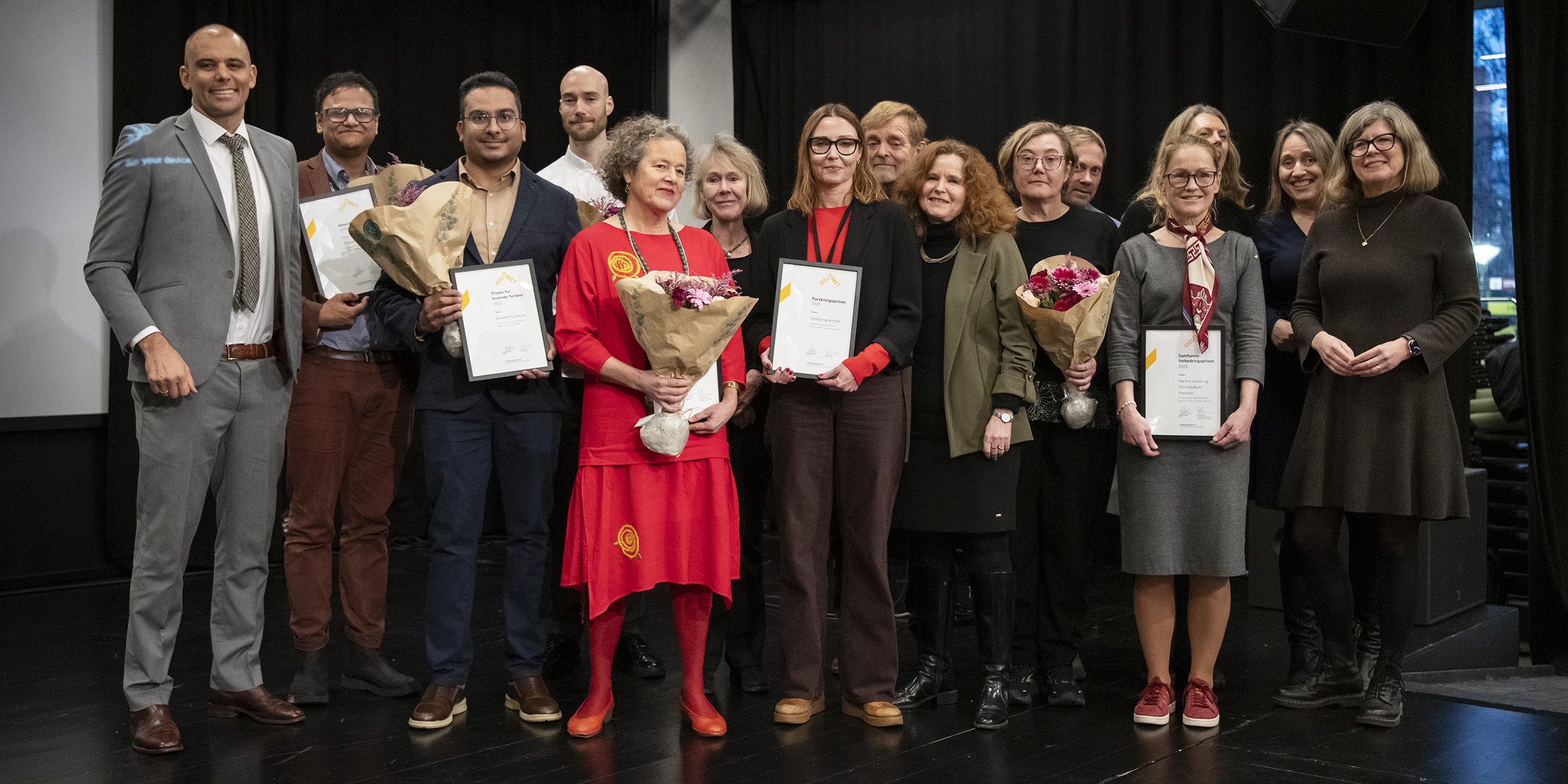
During this year's Research and Innovation Day, OsloMet celebrated the research and development work at the university. A total of six award winners were honored.
On November 27, OsloMet honored the winners of the award for the year's Promising Researcher, The Research Award, The Communication Award, The Innovation Award, The Social Improvement Award and The Master's Award. The award winners receive funding to continue working within their own field.
Read more about the criteria for the research awards og master's award.
Award winners for 2025
- The Social Improvement Award: Marthe Indset and Gro Sandkjær Hanssen (oslomet.no), Norwegian Institute for Urban and Regional Research (NIBR)
- The Innovation Award: Tulpesh Patel (oslomet.no), Department of Computer Science
- The Communication Award: Ingun Grimstad Klepp (oslomet.no), Consumption Research Norway (SIFO)
- The Master's Award: Anders Blomberg (oslomet.no), Master's student in applied computer and information technology
- Promising researcher: Bineeth Kuriakose (oslomet.no), Department of Journalism and Media Studies
- The Research Award: The violence program (oslomet.no), NOVA – Norwegian Social Research
OsloMet's three pro-rectors each presented their awards, and congratulated all the winners on their important contributions to knowledge.
– I am proud every time I am out and about talking about OsloMet, because our researchers, our knowledge and innovation have such a great effect on society, said pro-rector for social impact and collaboration, Carl Thodesen.
– Actually completing a master's is about finding structure in a large piece of work, and sticking to the work despite resistance along the way. I hope our master's students are happy and proud when they stand with their finished thesis in hand, said pro-rector for education, Silje Fekjær, in her introduction to the award ceremony for this year's master's thesis.
– Today we celebrate the knowledge we develop at OsloMet, and what it can be used for. Within our academic communities, our researchers excel in the sector when it comes to impact, meaning that others use our research both nationally and internationally, said Tanja Storsul, pro-rector for research and development.
The jury's reasons
Social Improvement Award
The prize is awarded to Marthe Indset and Gro Sandkjær Hanssen for their outstanding work on the EcoGaps project, where they have developed methods that make complex knowledge about nature management more accessible and applicable to municipalities and decision-makers.
Their work has shown how fragmented management can lead to nature loss, while at the same time developing practical solutions for more holistic nature management.
The impact of the researchers' efforts has been significant. In Nordre Follo, their work has contributed to legally binding provisions on ecological compensation, and in collaboration with NRK, the research has received national attention through the documentary "Norway in Red, White and Grey". They have not only communicated important findings, but also mobilized the public and created increased awareness of the need for sustainable land management. The fact that the project's methods and tools are arousing great interest in municipal Norway confirms the researchers' ability to translate knowledge into applicable improvement measures.
The two researchers have shown an exceptional commitment to bringing research out of academia and into the field of practice. Through collaboration with local and regional authorities, government agencies and research institutions, they have not only produced new knowledge, but also ensured that it is put into practice. With innovations such as the "Nature Fight" and policy workshops, they help strengthen our shared ability to make good knowledge-based decisions.
The Innovation Award
The award is given to Tulpesh Patel for his groundbreaking work in building bridges between education, research and business.
He is a driving force in connecting students to real-world issues in business. By developing and leading the courses under the umbrella of "Practical IT Project", Patel has initiated and built a structure and framework that enables engineering and computer science students to participate in practical projects in collaboration with start-ups and established businesses.
This collaboration has given the student community at OsloMet a unique opportunity to explore entrepreneurship, develop innovative solutions and experience what it is like to work in small, dynamic teams.
Patel's ability to inspire colleagues and challenge traditional ways of teaching and collaborating has set a new standard for how education can be more closely connected to the needs of society. His work has received attention both nationally and internationally and is a role model for how academia can contribute to innovation in practice.
Through initiative, commitment and vision, the award winner has created a collaboration that has given students invaluable experiences, strengthened OsloMet's reputation and contributed to concrete results of great importance for the entire region.
The Communication Award
The prize is awarded to Professor Ingun Grimstad Klepp, who has distinguished herself as one of Norway's leading researchers and communicators in her field through an impressive career.
Grimstad Klepp works with clothing, textiles and sustainable consumption, and has researched everything from environmental impact and overconsumption to the cultural significance of clothing, and has shown how textile research is relevant to everyone. Long before sustainability became a general topic, she advocated for more responsible consumption and production, and has put topics such as Norwegian wool and the problems associated with synthetic fibers on the agenda.
Where Grimstad Klepp has worked tirelessly to promote her professional expertise and participate in the social debate, society has not always listened. Now, however, the times have caught up with her.
Communication is a central part of her work, and she has a unique ability to make research accessible and understandable to consumers, politicians, business and research colleagues alike. Her clear and courageous voice has contributed to raising awareness of the textile industry's challenges and sustainable solutions.
The impact of her work is significant both within and outside academia. She has influenced political processes, contributed to promoting Norwegian wool and strengthening local value chains, and has also built a strong research environment at OsloMet's Consumer Research Institute SIFO, which is today a leading player in clothing research.
The Master's Award
The Master's Award goes to Anders Blomberg for the thesis Evaluation of Machine Learning Methods for Polymer Classification from Near-Infrared Spectral Data.
Blomberg has submitted a master's thesis that stands out as an innovative contribution to technological innovation, which can also have practical significance for the work of saving water quality in the Oslofjord. Thus, the thesis convincingly fulfills two of the criteria for the master's prize: "The work has generated new knowledge and is an example of insightful testing of new approaches to practice."
The remaining criterion is also more than fulfilled: "the work shows a particularly insightful and innovative discussion of theoretical and/or methodological approaches." As a master's thesis, the winner's work stands out as a rare independent contribution to knowledge for the development of tools for recycling, internationally.
The thesis was written for the master's program in applied computer and information technology, study program for robotics and cybernetics, in close collaboration with the Norwegian Institute for Water Research, NIVA. The task is based on the lack of affordable and accurate automated plastic sorting technology, which constitutes a major obstacle to effective recycling globally.
Blomberg, in addition to fulfilling the criteria for the award exceptionally well, has, through creativity, courage and hard work, solved major unexpected challenges in his work on the task, which the jury finds exemplary.
Promising Researcher
The Promising Researcher Award is awarded to Bineeth Kuriakose for high-quality research, especially in the field of artificial intelligence and human-machine interaction.
Kuriakose received his doctorate at OsloMet in 2023, with work in which he developed AI-based navigation assistants for people with visual impairments. Through user-centered design, experiments and advanced AI methods, he has contributed theoretical insight and the development of applicable technology. The work has been published in leading international journals. Today, he is a postdoctoral fellow at OsloMet with research in AI and investigative journalism.
Kuriakose is early in his career, but has already been associated with several different research and professional environments, both nationally and internationally. Among other things, he has collaborated with the German Research Center for Artificial Intelligence on human–AI collaboration.
Through his research, he demonstrates methodological depth, he is internationally oriented, and the research has strong societal relevance. The research is also characterized by a genuine and consistent interdisciplinary approach. Hans builds bridges between advanced technology development and key application areas within health, education, and journalism.
The Research Award
The prize is awarded to the Violence Program at NOVA – Norwegian Social Research for having built a new research field that has become a high-performing, interdisciplinary and internationally leading academic community.
The program delivers research of very high quality, and has published an impressive number of scientific works nationally and internationally. They have received awards and contribute heavily internationally through networks and conferences. The program leads the European research network on the children's home model.
The Violence Program has significant societal relevance, with its research on the extent of violence and abuse in the youth population, sexual abuse and violence, digital abuse, intimate partner violence, the legal system's handling of domestic violence cases, support services, policy design and management systems, negative social control, and honor-related violence.
The program actively disseminates information, and the research has great significance for policy and service design. For example, research from the program is referenced approximately 90 times in the Escalation Plan against Violence and Abuse and approximately 85 times in the Violence Text Committee's NOU.
The Violence Program has developed a professional community that includes fellows, master's students and researchers, and has close collaboration with partners from other research institutions and other sectors of society. The program has developed a new model for safeguarding informants and researchers to promote ethically responsible research.
This article was translated from Norwegian to English by adapting a draft made by AI.